
Chapter 10 Leptonic interactions
In this section we will study the electromagnetic and weak interactions involving the 3 generations of leptons.
10.1 Electromagnetic interactions
Background 10.1.1 (Feynman diagrams).
A convenient way to represent particle interactions are by Feynman diagrams. Associated with them are a set of Feynman rules, which are derived from quantum field theory and enable the calculation of the probability for each interaction to occur. We shall avoid the mathematical details, but use diagrams to understand the main features of the interactions.
The basic electromagnetic interactions where an electron either emits or absorbs a photon are
| (10.1) |
These are represented by the diagrams in Fig. 10.1, where by convention time runs from left-to-right. The corresponding positron processes are also shown in Fig. 10.1. In this case, time again runs from left-to-right, but by convention an arrow pointing to the right represents a particle and an arrow pointing to the left represents an anti-particle.
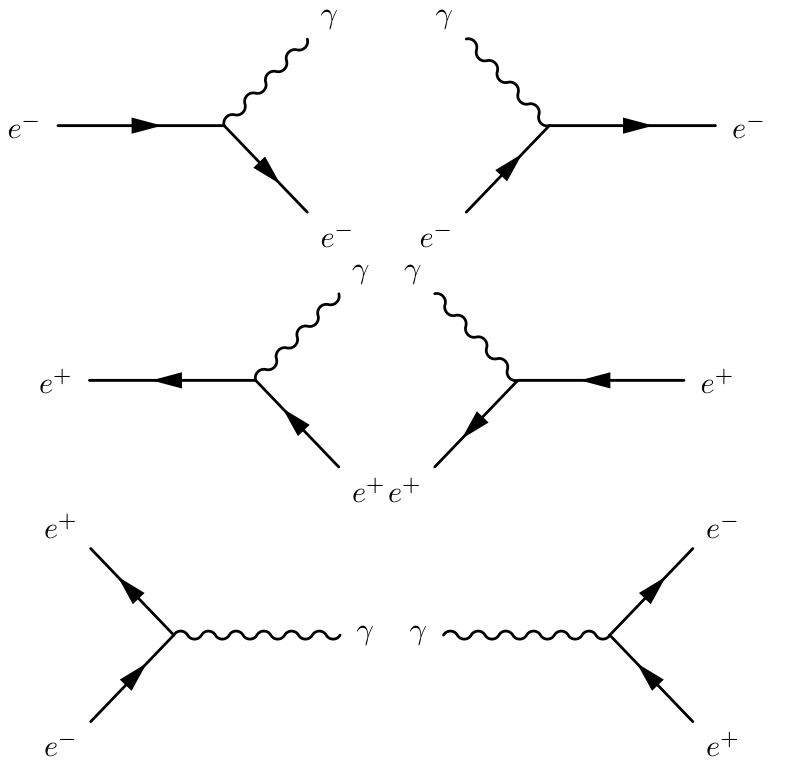

Notice that the arrows are continuous, which ensures charge (and lepton number, see later) conservation at the vertex. In Fig. 10.1 we also show the diagrams for annihilation and creation.
All these diagrams can conveniently be summarised by the vertex in Fig. 10.2, in which we also show the interactions of photons with other charged leptons.
10.1.1 Virtual Particles
Momentum is conserved at each vertex. However, it is easy to see energy conservation is violated for diagrams with a single vertex. We use to denote energy and momentum, which satisfy the relativistic relationship between energy and momentum Eqn. (13.3).
Consider the process (choosing the rest frame of the initial electron for simplicity)
| (10.2) |
where and . It is easy to see by calculating that energy is violated for all finite momenta .
This is why these processes are called virtual, as they cannot occur in isolation in free space. For a real process, we need at least two vertices combined in such a way that energy is only violated for a short time in accordance with the uncertainty principle. Incoming and outgoing free particles satisfy the relation Eqn. (13.3), but the virtual particles do not.
Example 10.1.1 (Range of Force).
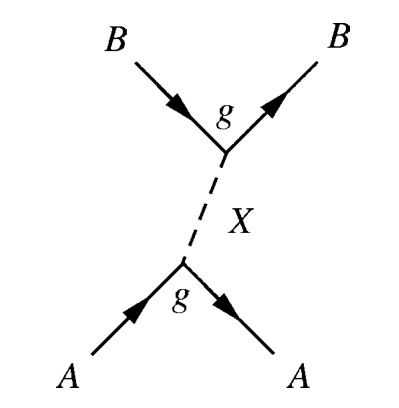
Calculate the range of the exchange force for the following process in the low momenta limit.
Solution.
In the rest frame of particle A the lower vertex represents
| (10.3) |
where , and . The change in energy is
| (10.4) |
In the limit this is . Using the uncertainty relation and then .
For example, the scattering process
| (10.5) |
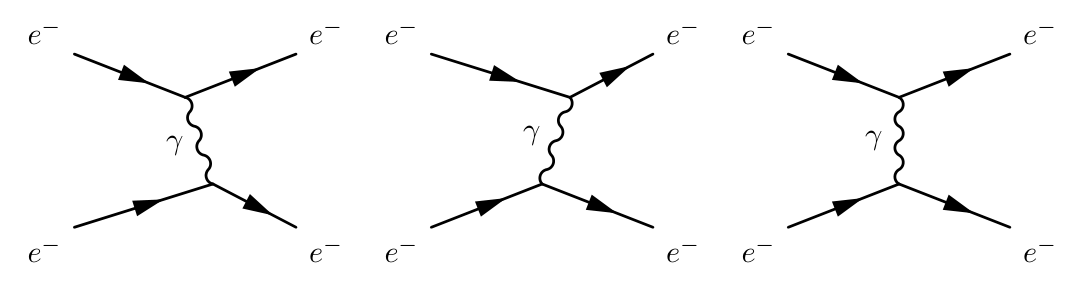
shown in Fig. 10.3 has two vertices and the exchange of a single photon. This is called the lowest-order diagram. You can keep adding more vertices to make more complex diagrams with more than one exchange photon, but these are lower amplitude processes.
10.1.2 Time ordering
Note that for Fig. 10.3 there are two ways of time-ordering the photon exchange (i.e. whether the upper initial electron emits or absorbs the virtual photon). Normally we draw one diagram, as shown in the bottom panel of Fig. 10.3, with the different time-orderings implied.
However is it crucial to remember these when actually calculating the probability amplitude of a process – they all contribute. You should also be careful with this when there is the exchange of charged , since the particular time-ordering will fix the charge.
10.1.3 Higher order diagrams
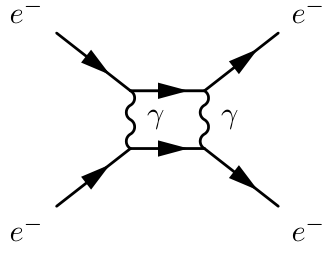
We can also draw more complicated diagrams, for example including two-photon exchange, as shown in Fig. 10.4 (question: how many time-orderings are there?). However, from quantum field theory, it is shown that each photon vertex contributes a probability of to the scattering process, where the fine structure constant is
| (10.6) |
Higher-order photon exchange is therefore suppressed.
10.2 Leptons and the weak interaction
Recall that the six leptons appear in 3 generations,
Each generation of lepton has an associated conservation law. Electron lepton number is defined as
| (10.7) |
Here the notation denotes an anti-electron or positron. is the number of positrons, is the number of electrons, is the number of electron neutrinos and the number of electron anti-neutrinos. It is found experimentally that, during the course of the interaction, the quantity is constant which is conserved in the interaction. There must be a symmetry which gives rise to this conservation law. Muon lepton number is defined similarly as
| (10.8) |
and the tau lepton number
| (10.9) |
The three quantum numbers , and are conserved in the standard model. How can we test to see if there are processes in which these laws are violated? We need to find a process that violates these laws. An example is
| (10.10) |
This process could occur on energy grounds since and . There is lots of energy, much more than is needed, but the process has never been seen.
The statement can be made more precise. We define the branching ratio as the probability that a process occurs in the decay of a particle. The probability that a muon decays into two electrons and a positron is found experimentally by measuring the fraction of such decays that occur out of the total number of decay events. Thus
| (10.11) |
In decays no decays have been seen, so we can say the branching ratio is less than . It could be much less than this and finite; it could be zero (since the decay violates the conservation of and ).
10.2.1 Leptonic weak interactions
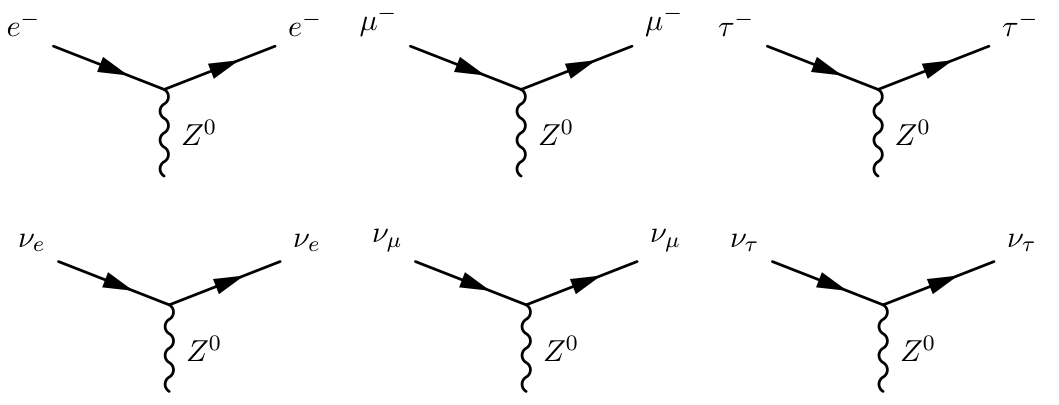
For the moment we focus on purely leptonic interactions. Weak interactions involving leptons are represented by exchange processes in which a or is emitted by one lepton and absorbed by another. In analogy with the electromagnetic case discussed above, the basic vertices for interactions are shown in Fig. 10.5. Notice that charge and lepton number are conserved at each vertex. The basic vertices for interactions are shown in Fig. 10.6. Charge and lepton number is also conserved. One should assign the correct charge to the under the understanding that it is either emitted or absorbed.

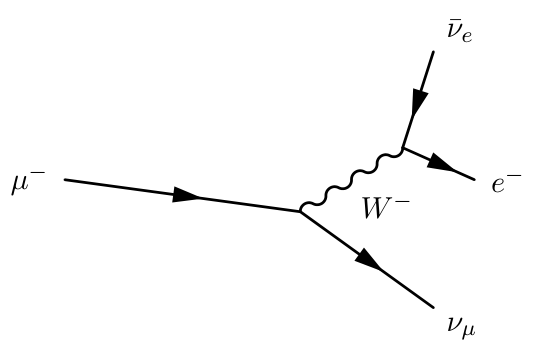
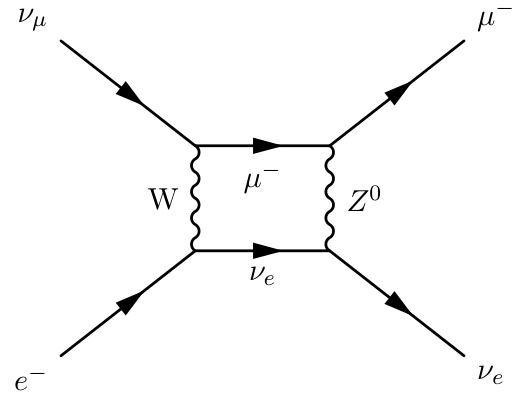
As an example consider muon decay. The dominant diagram is shown in Fig. 10.7. As with the electromagnetic interaction higher order processes are possible. A diagram for inverse muon decay, for example, is shown in Fig. 10.8. Detailed calculation, however, again shows these higher-order diagrams are highly suppressed.
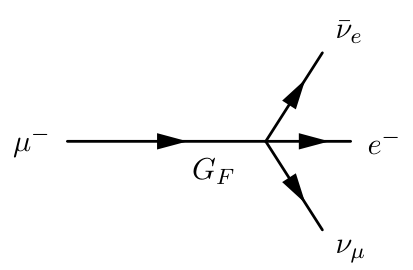
At low energies, the de Broglie wavelengths of the incoming and outgoing particles are much larger than the range of the exchange. In this case we can approximate the diagram by a zero-range point interaction, as shown in Fig. 10.9. The strength of the interaction is characterised by the Fermi coupling constant, ,
| (10.12) |
The relation between the coupling constant and the mass of the exchange particle is
| (10.13) |
where is a dimensionless parameter in analogy with the fine structure constant.
10.3 Exercises
Example 10.3.1.
For each of the following decays state a conservation law that forbids it
-
1.
-
2.
-
3.
-
4.
Solution.
-
1.
Conservation of electron lepton number violated.
-
2.
Conservation of electron lepton number and baryon number violated.
-
3.
This satisfies conservation of baryon number and charge, however the rest mass energy of a neutron only exceeds that of a proton by about 1 MeV. The rest mass energy of a pion is substantially more than this (around 100 MeV) so the conservation of energy is violated.
-
4.
Conservation of electric charge is violated.